
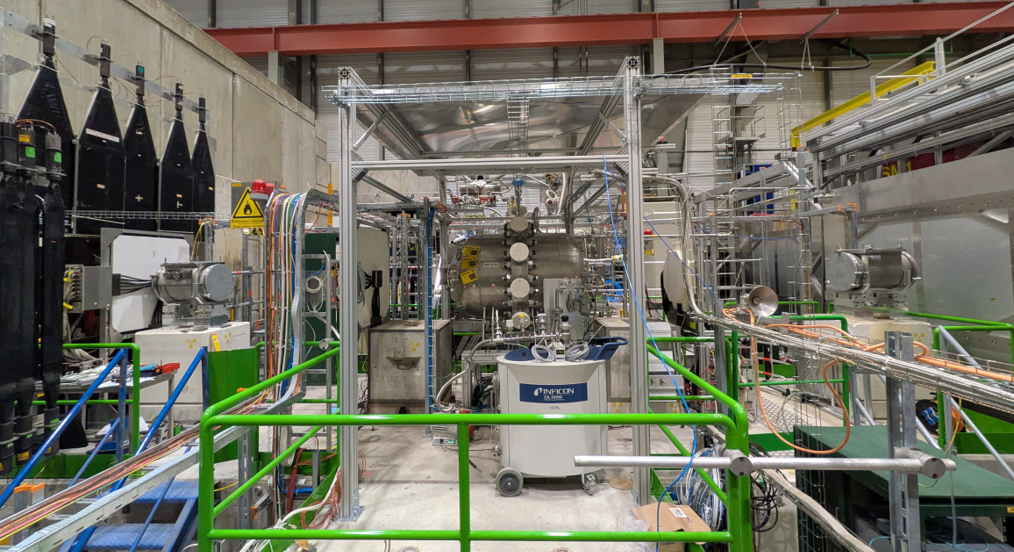
Proton Radius Measurement
Protons sit at the heart of every atomic nucleus. Its size is expected to be one of the best-known quantities in nuclear physics. Yet today, it is not.
This is the Proton Radius Puzzle. Two well-established ways of measuring the proton’s size give results that do not agree. The difference is small in absolute terms, about 5%, but large compared to the precision of the measurements. One method finds a radius close to 0.88 femtometres. The other gives about 0.84 femtometres. Both are internally consistent. Neither explains the other.
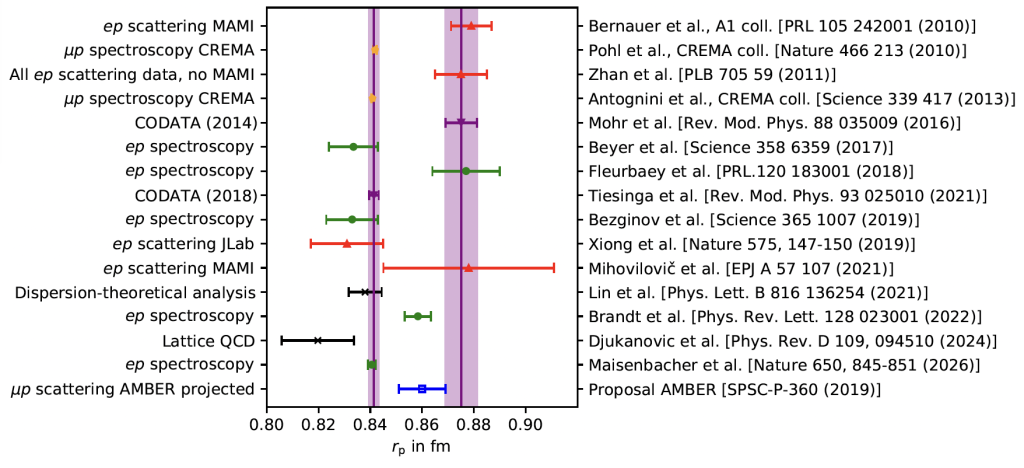
The first method uses electron–proton scattering: An electron beam is directed at a proton target, and the way the electrons scatter is measured. From the scattering angle, physicists reconstruct the proton’s electric form factor, which describes how its charge is distributed. By looking at this quantity at very low momentum transfer, they infer the proton’s charge radius.
The second method takes a different route. It studies muonic hydrogen, an atom where the electron is replaced by a muon. Because the muon is much heavier, it orbits much closer to the proton. This makes the energy levels of the atom more sensitive to the proton’s size. By measuring small shifts in these energy levels, known as the Lamb shift, the proton radius can be extracted.
Both methods are well understood but lead to different answers. As shown in the figure, there is also a discrepancy of the proton electric form factor determined by different experiments.
This is where the AMBER experiment at CERN comes in. It approaches the problem from a different angle by combining elements of both techniques: Instead of electrons, AMBER uses a high-energy muon beam from the M2 beamline of the SPS. These muons scatter off a hydrogen target. As in electron scattering, the key observable is the scattering angle. From this, the proton’s electric form factor can be determined across a wide range of momentum transfer.
Using muons changes the experimental conditions in important ways: Muons are less affected by multiple scattering as they pass through matter. They also produce smaller radiative corrections. In practice, this means fewer distortions to account for and a more direct connection between what is measured and what is inferred.
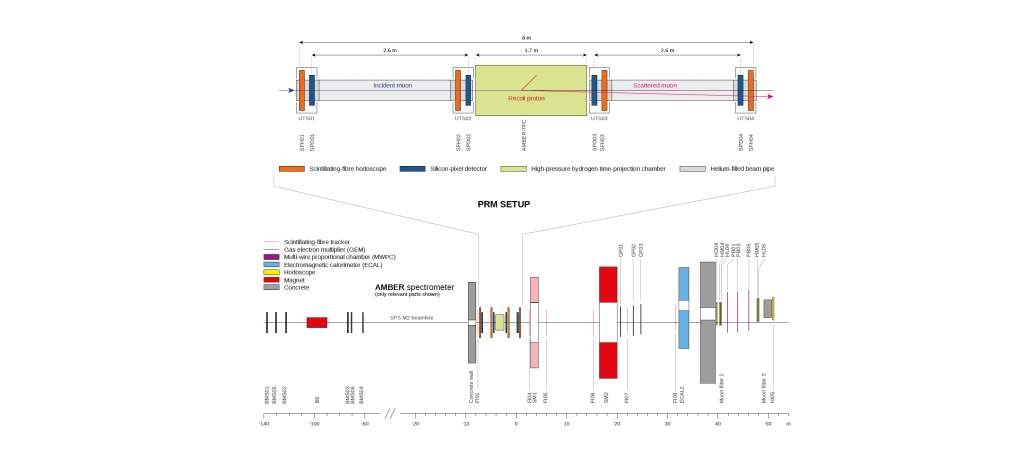
The Proton Radius Measurement (PRM) at AMBER will run from March to August 2026. It is the final measurement planned before the Long Shutdown 3. A beam test in November 2025 confirmed that the full system can operate stably under realistic conditions.
Reaching the required precision has required targeted upgrades across the detector.
Target
The measurement focuses on very small momentum transfers, where the sensitivity to the proton radius is highest. This requires a dense and well-controlled target. AMBER uses high-pressure hydrogen.
At the same time, the recoil proton must be detected to identify the interaction. For this reason, the target is not passive. The hydrogen fills a Time Projection Chamber, which acts both as the interaction medium and as a detector. This system operates between 4 and 20 bar, allowing different kinematic regions to be explored.
Vertex tracking
To determine the scattering angle precisely, the point where the interaction occurs must be known with high accuracy. This is handled by four Unified Tracking Stations placed around the target.
Each station combines scintillating fibre detectors with silicon pixel sensors based on ALPIDE technology. Together, they provide both timing and position information, allowing the interaction vertex to be reconstructed event by event.
Muon tracking
After scattering, the muon continue their way through the spectrometer. Their paths are measured, or tracked, by several tracking detectors, including Multi-Wire Proportional Chambers with upgraded electronics and Gas Electron Multipliers. Additional fibre detectors provide timing along the trajectory.
Photons emitted by the muon are detected in an electromagnetic calorimeter. These emissions must be measured, as they affect the reconstruction and need to be corrected.
Data acquisition
All detector systems are integrated into FriDAQ, a triggerless data acquisition system. Instead of selecting events in advance, the system records a continuous stream of data. This makes it possible to operate at the high rates delivered by the M2 beamline.
New detectors were designed to fit this architecture directly. Existing systems have been adapted to work within the same framework.